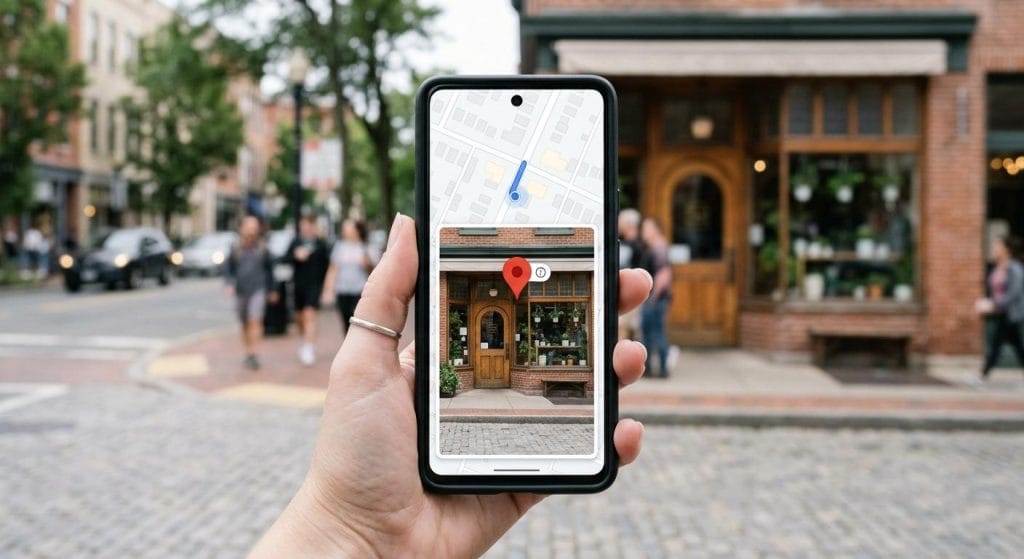
TL;DR: A Winston-Salem small business can rank higher on Google by fixing four things in order: completing its Google Business Profile, correcting inconsistent business information across the web, making sure its website is fast and mobile-friendly, and adding content that specifically references Winston-Salem. None of this requires tricks. It requires doing the basic, verifiable work that most local competitors are still skipping, and giving it time to compound.
Ranking higher on Google in Winston-Salem is a realistic goal for most small businesses, not an abstract one. It happens through a specific set of fixes, applied in order, and maintained over time. This isn’t a national competition against thousands of companies. It’s a local one, against a much smaller pool of businesses, many of which haven’t done the basics correctly.
What does “ranking higher on Google” actually mean for a local business?
For a local business, ranking higher on Google usually means showing up in the local pack, the map-based results with three business listings that Google shows for searches with local intent, or in the organic results below it. These two placements are driven by different signals than a national ranking would be, including proximity, Google Business Profile completeness, and local relevance signals rather than purely domain authority or backlink volume.
This distinction matters because 46% of all Google searches have local intent, according to Google. That means nearly half of all searches are people looking for something near them right now, not researching a topic in the abstract. A Winston-Salem plumber, bakery, or law office isn’t competing against national sites. It’s competing against a handful of other Winston-Salem businesses for the same searches, which is a far more winnable fight.
Is a Google Business Profile the starting point for ranking higher on Google in Winston-Salem?
Yes. An incomplete or unclaimed Google Business Profile is one of the most common reasons a Winston-Salem business doesn’t appear in map results at all. This is the single highest-leverage, lowest-cost fix available, and most local businesses haven’t done it correctly.
A complete profile includes an accurate business category, correct hours, a full list of services, and regularly uploaded photos. It also includes posting updates periodically rather than setting the profile up once and never returning to it. Google rewards profiles that show ongoing activity because it signals the business is active and reliable.
The stakes of getting this right are higher than most owners assume. According to Nectafy, 88% of consumers who search for a local business on mobile visit or call that business within 24 hours. If the profile has wrong hours, missing services, or no photos at that moment, the business loses the customer to whichever competitor’s listing looked complete and trustworthy.
Why does consistent business information across the web matter for local rankings?
Consistent business information, often called NAP consistency (name, address, phone number), matters because Google uses it to confirm that a business is legitimate and located where it claims to be. When the name, address, or phone number on a website doesn’t match what’s listed on the Google Business Profile, Yelp, Facebook, or an industry directory, Google has less confidence in the listing. That uncertainty can suppress rankings even when every other signal is strong.
A common example is a business that moved offices two years ago and updated its website but never updated its Yelp listing or an old directory citation. Google sees two different addresses associated with the same business name and treats the discrepancy as a red flag rather than resolving it automatically. Before doing anything else, a Winston-Salem business owner should search their own business name and audit every listing that appears for mismatches.
Does my website’s speed and mobile experience affect my Google ranking?
Yes, directly. Page speed is a confirmed Google ranking factor for mobile search, according to Google Search Central, and mobile accounts for more than 60% of all web searches, according to Statista. A Winston-Salem business whose site is slow or hard to use on a phone is working against both of these facts at once.
In practice, this looks like a site that takes several seconds to load on a phone, or one that requires pinch-zooming and horizontal scrolling to read a menu or service list. These are common symptoms of older templates built years ago for desktop screens, and they push both rankings and conversions down at the same time. A business running a fast, mobile-first WordPress site has a structural advantage over competitors still running outdated or bloated templates, independent of how much content either site has.
Owners who inherited a slow site from an old Wix or Squarespace build often ask whether it’s worth rebuilding versus patching. That question is covered in more detail in Should I Rebuild My Wix Website or Switch to WordPress?
Does content about Winston-Salem specifically help my rankings?
Yes. Location-specific content, meaning pages, service descriptions, and blog posts that name Winston-Salem and its surrounding neighborhoods directly, gives Google concrete evidence that a business is relevant to local searches. Generic stock service copy that could describe a business in any city gives Google nothing to connect that business to Winston-Salem searches specifically.
According to DemandMetric, businesses that blog generate 67% more leads than those that don’t. That advantage compounds further for local businesses when the content answers the real questions local customers are searching, such as what a service costs in Winston-Salem or which neighborhoods a business serves. A roofing company that writes about storm damage patterns specific to Forsyth County is giving Google and readers something a generic national competitor cannot.
How long does it actually take to rank higher on Google in Winston-Salem?
Local SEO is not instant, and any promise of guaranteed fast rankings should be treated with suspicion. Real, sustained ranking improvement comes from consistent work applied over months, not a single fix applied once.
McLean, founder of GM Webworks, experienced this firsthand. At 15, he launched his own car detailing business in Winston-Salem and began teaching himself web design and local SEO. It took about two years of consistent, ongoing work, not a single tactic, for that business to reach the top of local search results by age 17. That timeline reflects what disciplined fundamentals actually look like in this exact market, and it’s a more honest expectation than any promise of overnight results.
What should a Winston-Salem business owner do first to rank higher on Google?
The order matters more than the individual tactics. First, complete the Google Business Profile fully, including category, hours, services, and photos. Second, correct every NAP inconsistency across the website, directories, and social profiles. Third, confirm the website loads quickly and works cleanly on a phone. Fourth, begin adding Winston-Salem-specific content on an ongoing, not one-time, basis.
- Complete and actively maintain the Google Business Profile
- Audit and correct business name, address, and phone number across every listing
- Confirm the website is fast and fully usable on mobile
- Add location-specific content consistently over time, not as a single project
Done correctly and maintained monthly, these four actions account for the majority of ranking improvement most small businesses will realistically see. For a deeper breakdown of how these fundamentals combine with map-specific visibility, see How Do I Get My Dallas Business to Show Up on Google Maps?, which covers the same mechanics applied in a different metro.
Ranking higher on Google in Winston-Salem comes down to a short, specific list done consistently, not a secret algorithm trick. The businesses that treat these four fundamentals as ongoing work, rather than a one-time project, are the ones that see results hold and compound over time.